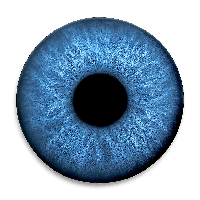
What iris markings and colours mean
Written by Boyan Minev, Founder · Last reviewed June 6, 2026
When an iridologist studies your eye, they’re reading two things: where a feature sits (its zone on the iridology chart) and what the feature itself is. This guide covers the “what” — the markings and colours — in plain language. These are interpretive signs in a complementary practice, not medical findings.
Common iris markings
- Lacunae — small leaf- or eye-shaped gaps in the iris fibres. Read as a possible area of inherited weakness in the corresponding organ zone.
- Crypts — darker, diamond-shaped openings deeper in the fibres, often read as a constitutional predisposition.
- Nerve rings (cramp rings) — concentric arcs across the iris, traditionally associated with nervous tension or stress being held in the body.
- Lymphatic rosary — a ring of small cloud-like spots near the outer edge, linked in the tradition to lymphatic congestion.
- Radii solaris — spokes radiating out from the pupil, sometimes read as pathways of irritation or “toxic” tendencies.
- Pigment spots & tophi — darker spots (psora) or yellow-white deposits, each carrying their own meaning in classic iridology.
What iris colours suggest
Colour works on two levels. Your base colour places you in a constitution type — blue/grey (Lymphatic), brown (Hematogenic), or green/hazel (Biliary/Mixed). On top of that, localised colour variations — a patch that’s darker, lighter, or differently toned than its surroundings — are read as something worth noticing in that specific zone.
How Iris AI reads them
Iris AI uses AI vision recognition to detect these features automatically across 12 zones in both eyes, then translates what it sees into a structured wellness plan — diet, herbs, nervous system, emotional balance, and movement. It does in minutes what would otherwise take a careful in-person reading.
An honest note
Iris markings and colours are interpreted within iridology’s own framework, which is a complementary wellness practice rather than a clinically validated diagnostic method. A marking is a prompt to pay attention — not a diagnosis. For any medical concern, consult a qualified healthcare professional.